
This is a fictional story that regards a theoretical Hurricane. The following scenario is derived from historical research and realistic data points, and is intended to present a dramatized version of events that may transpire from a possible worst-case-scenario Hurricane landfall in the Mid-Atlantic states of the U.S. East Coast. The purpose of this newsletter is to spread awareness of the danger communities along vulnerable coastlines (that have yet to be hit by a major tropical cyclone impact) with regards to the reasonable worst case scenario they may face from a tropical cyclone. No fictional characters in this episode are intended to represent real persons, unless explicitly stated by name. Additionally, this piece uses AI generated images. However, NO writing material is written by AI. It is and always will be written by myself, the author.
Hurricane Imani—The Clock Strikes Landfall.
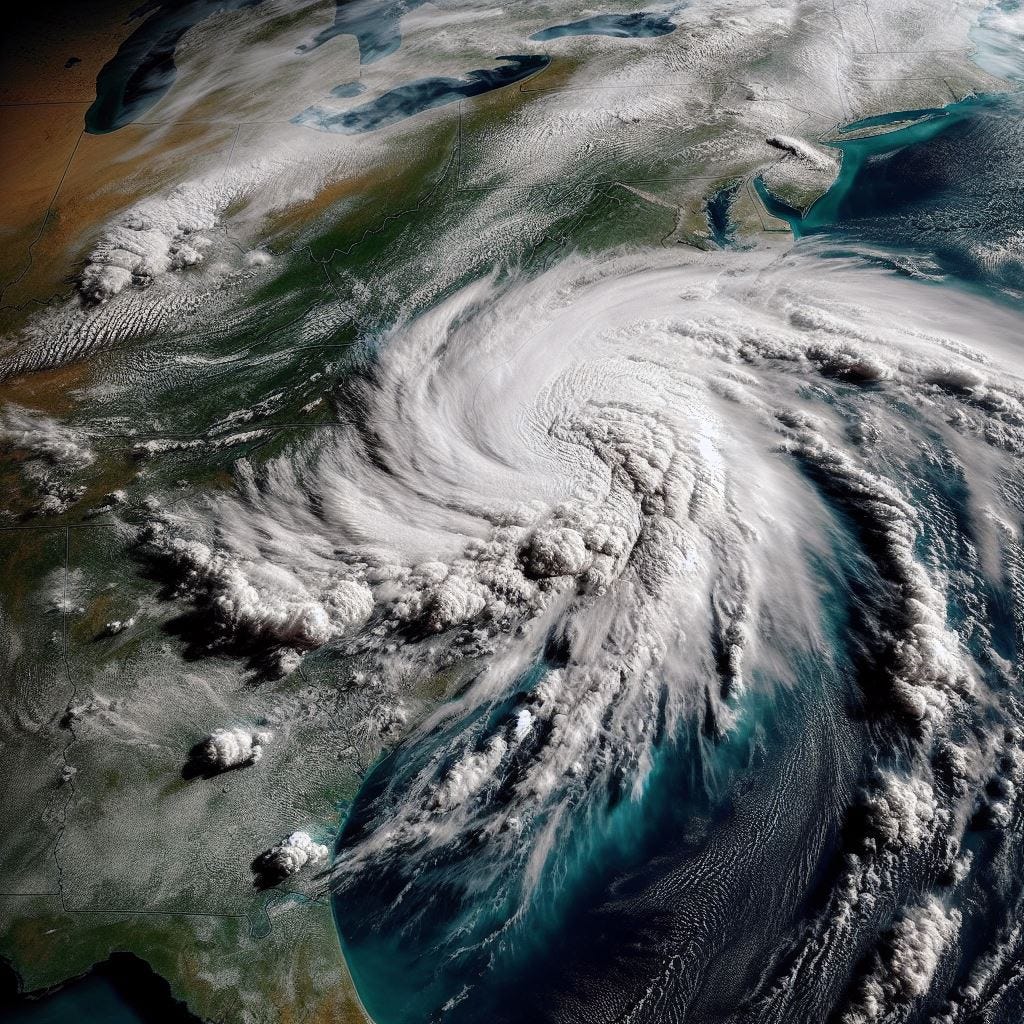
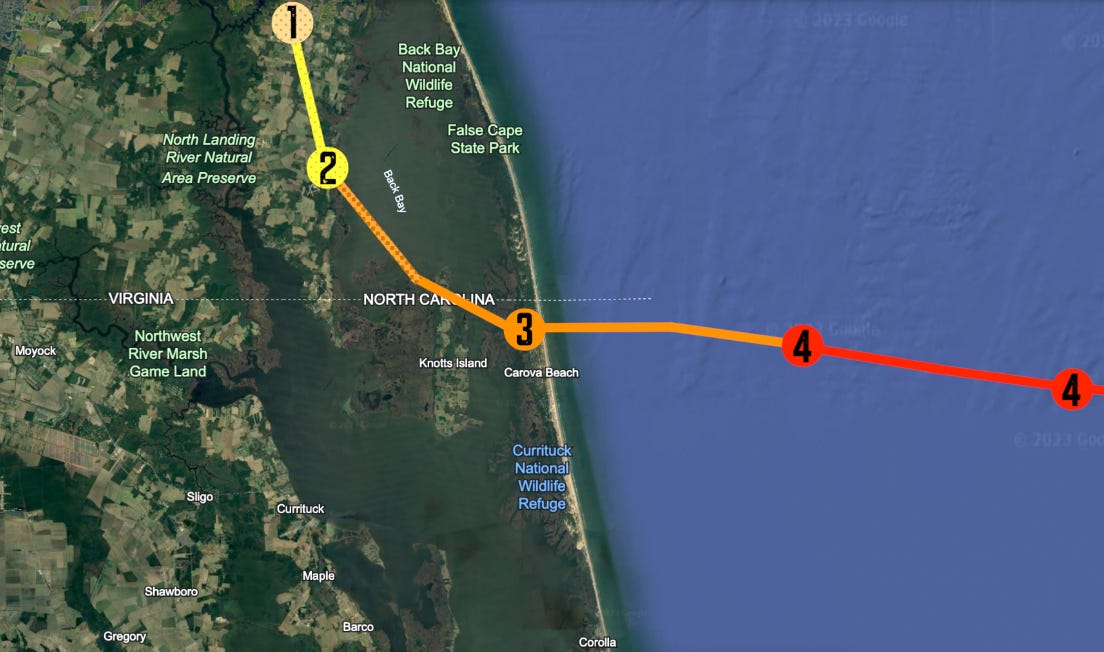
The day is September 10th, 2027… the time, 10:27 am EDT. The trodden sands of Carova Beach—a tiny, unincorporated community located along North Carolina’s Currituck Peninsula—have been consumed and dissolved by the Atlantic Ocean’s salty, overflowing saliva. An unsettling calmness has settled amongst the surreal air, leaving a ringing in the ears of those still hidden in their homes. An opaque sunlight streams down through a lens coated in a soapy film; and on every, inescapable edge of the horizon, the clouds are terraced like rice paddies, and spinning like the rings of Saturn. The fateful moment had arrived: Hurricane Imani, after two weeks of crossing the Atlantic expanse, has made her landfall.
Hurricane Imani Tropical Cyclone Update
NWS National Hurricane Center Miami FL
10:30 AM EDT Wed Sep 10 2027
…EXTREMELY DANGEROUS CATEGORY 3 HURRICANE IMANI MAKES LANDFALL
ON THE VIRGINIA-NORTH CAROLINA BORDER…
…10:30 AM POSITION UPDATE…
NOAA Doppler radar imagery indicate that the eye of Imani made
landfall along the coast of North Carolina’s Currituck Peninsula near Carova Beach around 10:30 AM EDT. Data from an Air Force Reserve
Hurricane Hunter aircraft indicate that Imani’s maximum sustained
winds were near 120 mph (205 km/h). The latest minimum pressure
central pressure estimated from reconnaissance data is 949 mb (28.02
inches).
The Hurricane that had started out life timidly, in the West African womb of fertile thunderstorms and tropical convection, had burst to her feet, devoured hungrily the conditions around her, and spread her arms out wide… leaving a shadow of broken darkness in her wake.
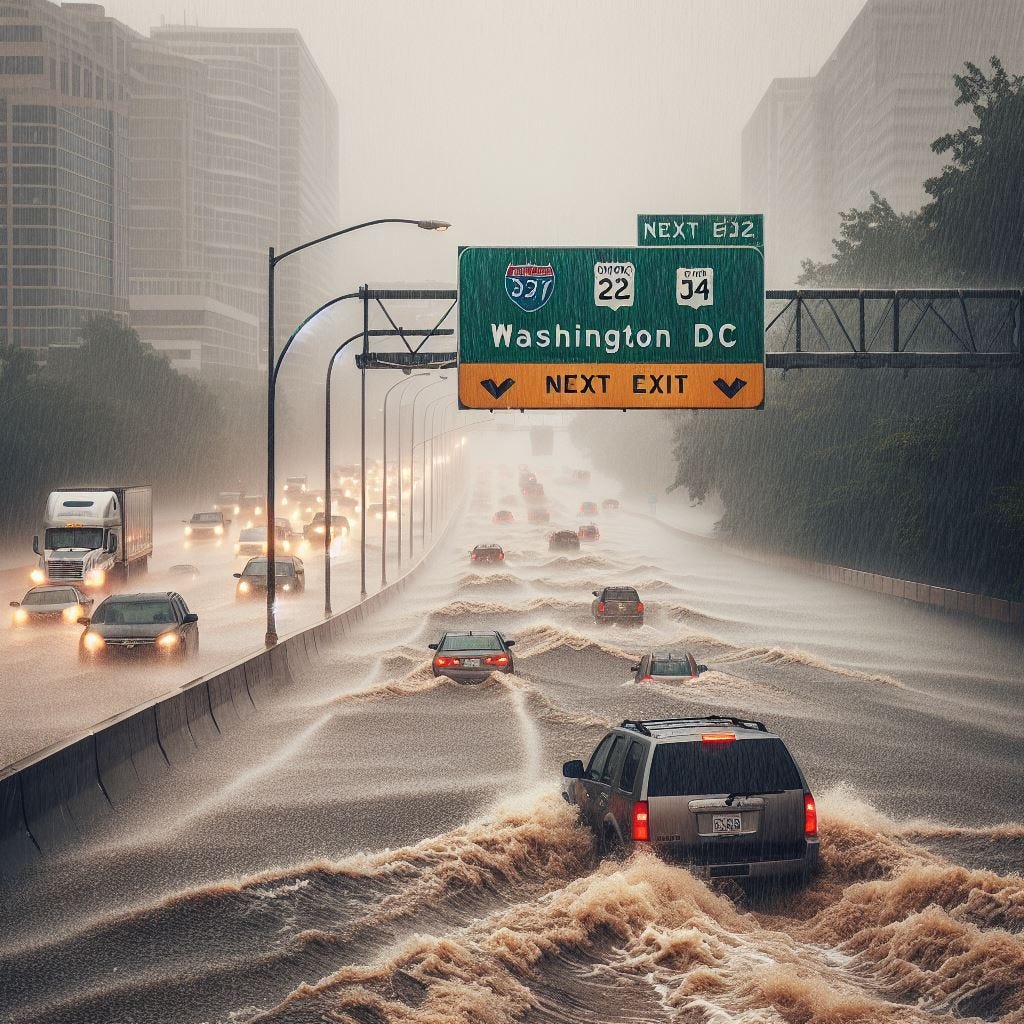
A fatalistic combination of Imani’s erratic movement, and the painstaking difficulty of evacuating 1.7 million people from the Hampton Roads area, has left countless thousands trapped under a suffocating plastic bag of storm surge. Many have been caught trapped in traffic jams as the catastrophic floodwaters rise… some are drowning inside vehicular tombs of metal; while others are ultimately unable to swim free from the ocean’s clenched fists.
Eyewitness reports tell of hundreds of homes that are being obliterated to mere piles of structural wood beams. Dense clusters of destroyed remains float on the surge water’s surface in mats—tangled masses of soaked stuffed animals, torn bed sheets, and broken picture frames. Thousands more residences are at least partially pulverized by the vicious tidal waves. It seems that not a single manmade structure in Hampton has escaped the irreversible water damage inflicted by a storm surge of up to 15 feet. People cling desperately to the dying red battery symbols on their phone screens, recoiling in despair and dismay, as the press of their call buttons leads to nowhere. Communications in and out of Hampton are now, completely severed.
Reports show that Norfolk Naval Shipyard has been severely damaged by heavy storm surge inundation, and there are fears that the U.S. Navy’s ability to maintain their Atlantic fleet has been jeopardized. Along the banks of the James River, the Dominion Surry Nuclear Power Station suffers grave flooding damage; fortunately, authorities had slowly shut down the facility prior to Imani’s arrival. Regardless, viral social media posts falsely claim that the nuclear power plant is failing; and the misinformed news becomes so prevalent on TikTok and Instagram, some people actually get in their cars and flee inland, fearing a catastrophic meltdown is imminent. Meanwhile, the Dominion Energy Liquefied Natural Gas Terminal in Lusby, Maryland is having its safety operations compromised by the Chesapeake’s rising tides.
In the immediate minutes after landfall, Hurricane Imani’s core takes a drastic shift in direction, lifting up to the north and entrenching the storm’s northern eyewall—which is still ripping with Major Hurricane-force winds—deeper into the already-devastated city of Norfolk, Virginia. The storm surge from the Chesapeake is a non-negotiable wall of water, and it is consuming everything in its path.
Docks and piers are smashed to hopeless smithereens. Glistening white boats—looking like the Potomac River’s native Tundra Swans—are tossed and heaved atop the tumultuous waters. The floods are a horrifying, toxic turmoil; a churning, seething mass; a washing machine, but turned inside out and filled with innumerable quantities of trash, cars, and debris. It is a sickly, merciless force; a cake pan mixture whose primary ingredient, is the splintered remains of people’s lives.

It’s now past midday on September 10, and land-induced friction is grinding away what’s left of Imani’s shapely curves, uncoiling the storm to below Major Hurricane status by 1 pm EDT. However, this is merely a formality at this point, as the storm’s size and inertia negate a rapid improvement in conditions, courtesy of the weakening. Storm surge inundation around the Chesapeake’s rim peaks in a violent crescendo. Seawater charges up the bay like the Running of the Bulls, piercing horns of surge into Maryland’s heart, and trampling over Virginian townships such as Deltaville, Hallieford, and Reedville, to name a few. As the world gazes inward through the limited eyes of news cameras and storm chasers’ phones, footage and information on the ongoing disaster suddenly becomes scarce. Endless replication and reposts of the same initial seconds of footage, loop, spin and repeat on social media. No word is going out… and no word is coming in. Now, only the stormiest of nightmares can envision what the scene inside the Hurricane’s proverbial radiation zone, might look like.
However, not even this horrific scale of natural catastrophe is enough to satisfy Imani’s insatiable appetite for human suffering; it never was going to be, from the very beginning. No… this was only the first phase of the diabolical Hurricane’s plans.
As the fiery, crimson sunset descends over Imani’s cloud tops—making her mien that of a burned marshmallow—a new threat is emerging from the twilight’s shadows. In the upper-level environment encompassing the swirling storm, steering currents are beginning to crumble away, like aged mortar between atmospheric bricks. Meteorologists and weather enthusiasts alike gaze upon their computer screens in dread. Model agreement becomes unanimous: Imani is going to stall, and milk herself of every torrid drop of water that is contained within her clouds in place. The disaster is going to expand to a second offensive front; to a trench war of watery attrition (as opposed to the acutely violent coastal impacts).
A converging pincer movement of Chesapeake storm surge and torrential rain now has the Washington DC-Baltimore metroplex surrounded. Millions of people living in these centers of American urbanization have their eyes on the calamity along the Virginian coast—not realizing that they, too, will not be able to escape from the liquefied future creeping up to their doorstep.
September 11-12—Bottom of the Valley.
(A Storm Chaser’s Account of the Floods.)
Kirk Cashman was in a state of weary consciousness. He held a stiff expression that was reflected in the gray light. His senses picked up an ambience that was dim, isolated, and narrow. He was surrounded by the pattering of a steady rain on the cold, metal skin of his car; the drops almost sounded hard and dry, even though they were wet. Intermixed in this atmosphere of assailant, ticking corn kernels, was an indistinguishable voice—it sounded male, muffled, and echoed; shouting, but not too loudly; enthusiastic, but insincerely such; near, yet shrouded in a dense cloud of immeasurable distance. He thought the voice to be that of an advertiser or auctioneer, but painted over by the whir of the car’s tires.
Cashman had felt a lachrymose feeling of drear that morning of September 11th, 2027—almost so that he wondered if it were even safe for him to drive. It contrasted and frustrated his usual, thrill-seeking self behind the wheel; a self that flourished in the places that most others considered dangerous. Cashman had no particular problem with blunt sunlight—only that he felt vexed for the lack of acknowledgement that people liked it because of its safe predictability. From an early age, he’d developed this inexplicable, and what he felt as a distinctly masculine, urge to run away from monotony and comfort zones and the molded prefectures of ‘Los Angeles weather’. It was a hobby that quickly devolved into an obsession; sprouting from the landfall of Hurricane Wilma over Cashman’s childhood home in southwest Florida, when he was just five years old; and during which his younger sister—Betty—was born at 1:19 p.m. that stormy day, at the hospital.
But today was a day that was 2 decades older—and, 24 hours removed, from the landfall of Hurricane Imani on the North Carolina-Virginia border. Cashman had exhausted his resting supply of adrenaline watching the news coverage of the landfall at a hotel in Richmond, the previous day. It had been later that night, that Cashman’s home brewed team of storm chasers—close friend Nick Ryans; freshly graduated UCLA computer scientist Dustin Mckinstry; and Cashman’s claim to complicated history with, Akari McGillis—had split up between their three, custom-designed amphibious chasing cars. Ryans and McKinstry had headed off towards Baltimore at the crack of 5 am; while Cashman organized his own rendezvous with Akari in Washington DC (she, too, had already departed earlier in the morning).
Driving his amphibiously-converted car—whom he affectionately referred to as Newt—Cashman arrived at the Elliot Hotel just after 7 am, and had to crisscross the parking lot to find a spot in the back corner. After a last gulp of the energy drink stashed in the center console’s cup holder, he took it upon himself to flip the hood of his black jacket over his dark hair, and step out into the packed parking lot and the dense rainfall. He circled around to the hotel’s entrance, and entered a lobby whose cordial warmth was in harsh contrast to the cold reality of the storm outside. He noticed, as he walked to the reception, the heads of businessmen seated in the lounge, all uniformly tilted with faces lit by LED reflection. They were laughing boorishly at text messages on their phones.
Behind the reception clerk’s desk stood a pretty woman with mahogany curled locks and long, silvery earrings. She greeted Cashman with a spunky cheerfulness that did not fit the rain nor the morning; but he appreciated it nevertheless. Moments later and with room key in hand, he was knocking on Akari McGillis’ room door, which was next-door to his own.
When the clicking of chains and deadbolts slipped free, and the door eased open, a young woman stood above the gold-rimmed threshold. She wore an identical black rain jacket as Cashman, but she seemed to shape its utilitarian essence into an unrealistically elegant physique. Her hair was egg shell blonde and only just tickled the bones of her shoulders. She was surrounded by an atmosphere of fierce coldness and unwavering confidence. The wet sheen in her russet eyes reflected a woman whose desire to seek out the treacherously adventurous trumped above all else.
“We should go to Arlandria first,” Akari said immediately, as if they’d already been in the middle of a conversation. “That’s where Nick thinks the flooding will start and we don’t have much time before the roads start getting blocked.” She turned and sank deeper into the room abruptly. Cashman followed inside, closing the door hesitantly behind him. The air inside was artificially cold—an ode to the breathless work ethic that Akari preferred to subject her air conditioning units to. The television was on and muted, silently flashing the first images of the immense devastation on the Virginian coast. On a small coffee table in the middle of the room sat an opened camera case.
“We’ll be lucky if the main roads aren’t closed off already,” Cashman said as Akari straddled an ottoman next to the camera case, and began snapping on various protective cases to the equipment inside. “At the rate it was coming down in the parking lot, I reckon we should see the crocodiles coming up from the sewer drains by tonight.” He laughed dryly at his own joke, then swallowed it down when Akari’s head did not look up. “So… I take it Nick called you, then?”
“Yes,” said Akari, “though he still sounded pretty piqued that you sent him up to Baltimore instead of down here—seems to think DC’ll be ground zero. He mentioned something about it ‘being bad enough’ you chickened out of Virginia Beach.” The mention of this thing felt like a sting in Cashman’s skin, and he couldn’t tell if Akari relished in planting that barb or not.
“And?” Cashman tried to deflect her concealed cruelty. “Did you back me up or not? You’ve been hiding from this question since Wednesday.” He maneuvered around the case and coffee table, and sat at the foot of Akari’s bed.
Akari shrugged, her nimble fingers still fiddling with the cameras absentmindedly. “You know I never disagreed with you.”
“You never agreed, either.”
“What?” Akari looked at him sarcastically. “You don’t think Nick will get over it? You think he’ll up and leave the group? No chasers went down there, right? So what we were the first ones to realize Imani was going to make landfall north of the Outer Banks? He knows full well the highways out of Chesapeake were gridlocked; that the surge was too minacious for even the most unbreakable of men. Can’t we just drop it already? I’d certainly hope that you’ll manage to put it in the past before he does.” She lowered her head again, making her implied undertones a little too clear.
“I apologize,” said Cashman, his voice calmer, and more explorative than hers, “if I expressed concern for my crew’s safety. Trust me, there’s nothing like ten-thousand missing people—any one of which I know we may have been able to help—to make you grow a guilty conscious overnight.” He leaned forward, seeking out her shoulder. He placed a hand there gently, which prompted a cold scowl from Akari’s eyes as they flicked toward the features of his lightly bearded face. “But that’s in the past, now” he continued. “We’re in the present, and we can see the future—and all I can see is water. Three feet of rain in as many days can’t just disappear, Akari. This storm is strategically exploiting topography in a way I’ve never seen, and the freshwater flooding may be just as bad as the saltwater. We’re here to show the world what’s going on. Our show, is only just beginning.” He finished firmly enough to conclude the discussion, and dimly enough to stay below the octave of the splattering rain on the window.
Akari tried to keep a trace of venom in the air, but a downwards flicker of her eyelids was enough to unwind the coiled tension between them. She softened her wooden features into indifference, gesturing reluctant agreement; and the rain’s ambience returned.
Cashman set his reptilian jaw, and picked up a camera himself. He knew that no true, experienced storm chaser—who felt a lust for the extreme, the wicked, and the dangerous—would normally surrender the opportunity for confronting the eyewall of a Cat 3 Cape Verde as it roared ashore. Telling this to chasers—to people like Akari, Ryans, and even Cashman himself—is like promising a kid a BB gun for Christmas, then taking it away from them on Christmas Eve. But Cashman stiffly maintained the confidence in his decision—as the team’s colloquial leader—to nix the coastal chase, when there would be more than enough of a natural catastrophe to cover in DC and Baltimore in the subsequent days. He believed that the worst case scenario—the ones that told of the difficulties, inefficiencies, and fears of evacuating everyone from the Hampton Roads region when a Hurricane approached—had come to a terrifying fruition’ meaning that if they had tried to reach the coast, they could’ve become trapped in a horrid situation. He believed that he had unequivocally made the right decision, for himself and his team.
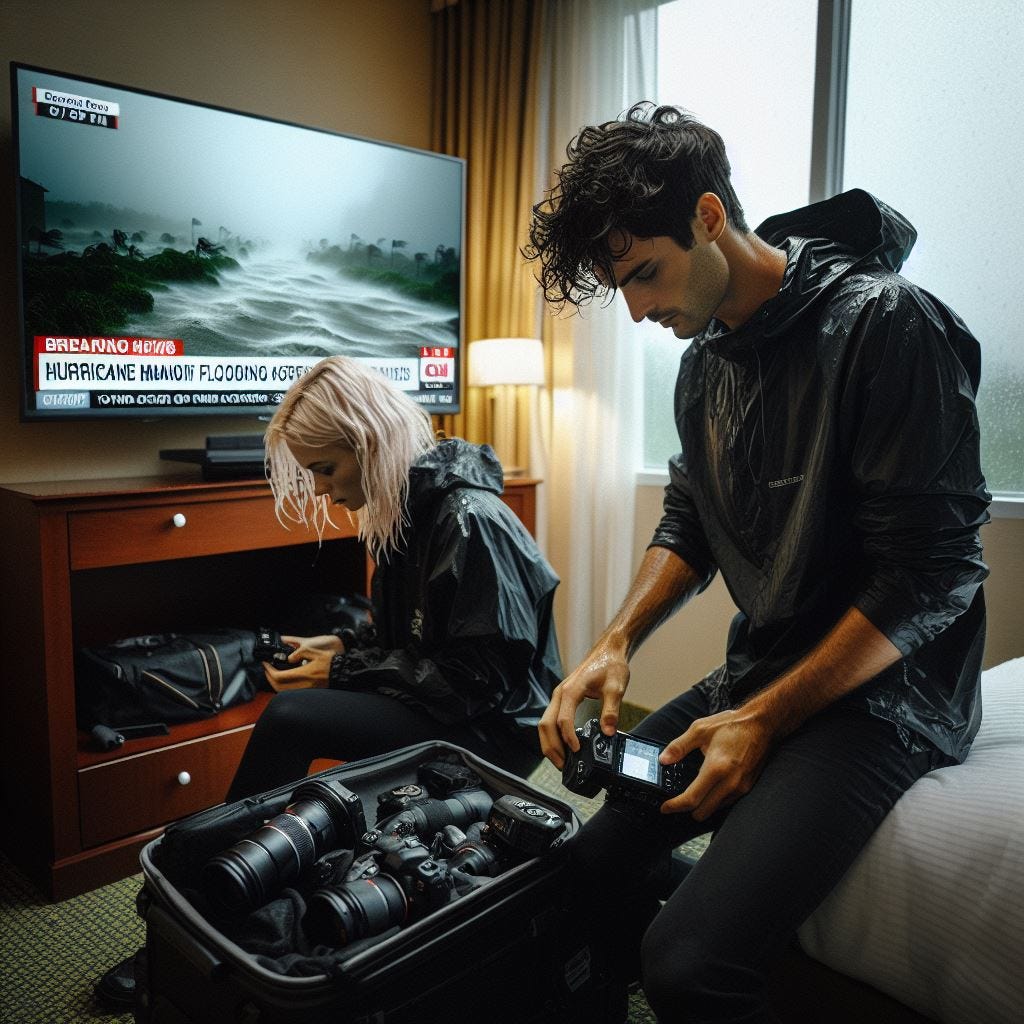
Just then, a buzzing alarm screamed from Akari’s pants’ pocket. Cashman’s own phone followed suit just seconds subsequent. They pulled them out, and took just an instant to gawk at the ‘Flash Flood Warning’s displayed on screen, before throwing the camera case closed, and gathering the rest of their equipment.
Outside, Imani beckoned them forward.
Through September 11th, the core of Tropical Storm Imani continues to move northward slowly, parallel to the length of the Chesapeake Bay. Despite the storm’s weakening, her mammoth radius of gale-force winds (which only continues to grow as the cyclone’s tightly wound eyewall unravels) negates the effects of the lesser wind speeds. The saltwater tidal surge pushes onward like an implacable military spearhead, thrusting up the Potomac River and flooding the surrounding towns. Colonial Beach is the first to be violently penetrated by the rising waters, with up to 6 feet of storm surge filling ground floors and completely destroying shallowly built sheds and other structures. The neighborhoods on Cobb Island suffer a similar fate, with water rising even deeper, to around 7.8 feet above normally dry ground.
Concomitantly, with the grave erosion of the steering currents, the effects of Imani’s excruciating forward speed begin to flow into action. Torrents of rain saturate the Potomac River Basin, barricading the oncoming storm surge like a freshwater dam. With nowhere to go, the accumulating floods spread like a toxic fungus, inundating the dozens upon dozens of low-lying towns and communities along the Virginia-Maryland border. Most residents here did not evacuate, and with most structures not elevated by stilts like on the coast, the flooding damages begin to pile up catastrophically. The Patuxent River acts as the door to this prison cell, closing off any escape routes for the water to drain away freely.
Back at ground zero, in the now-devastated lower Chesapeake regions, the surge flooding is emptying back into the Atlantic rapidly. With Imani’s counterclockwise core now to the north of these cities, the prevailing wind acts on the ocean in reverse, pushing the surge back out like the withdrawal before a tsunami. As the scourged grounds of Hampton, Norfolk, and Virginia Beach emerge from the sea‘s raging chaos, a nearly post-apocalyptic hellscape is gradually unveiled.
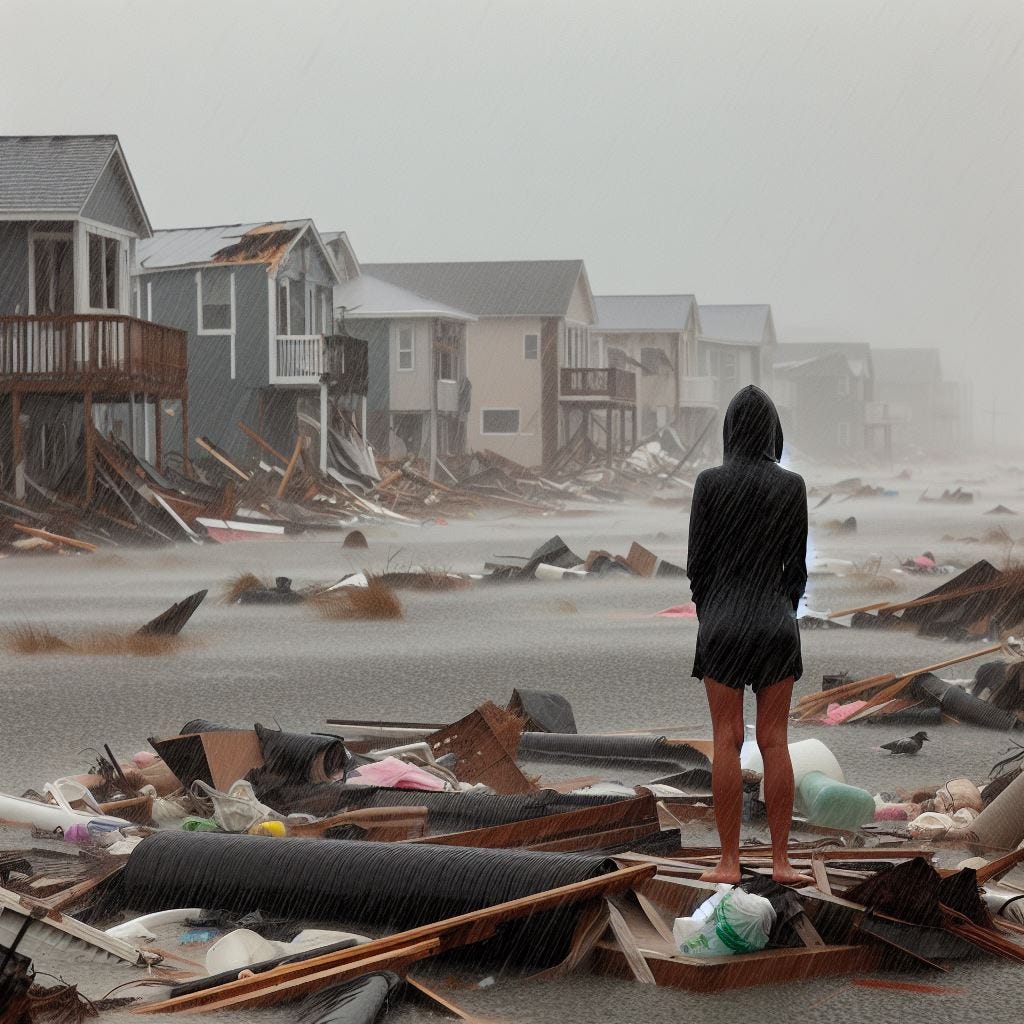
Norfolk has suffered the most extensive desecration, with over 90% of the city’s buildings sustaining severe water damage. The impacts are similar in Virginia Beach, though to a lesser extent, as some of the inland areas escaped surge inundation. But for the Hampton and Hampton Roads complexes, the devastation is horrendous. Unlike Norfolk, the surge’s impacts here are concentrated more acutely near the coast, where entire neighborhoods have been chewed up by Imani’s teeth, digested by the Chesapeake’s salty enzymes, and swallowed into the Atlantic stomach. Overall, the human infrastructure comprising the Virginia Beach-Norfolk-Newport News metropolitan area has been, in spots, completely scrubbed clean by Imani’s punishing, acidic sponge of storm surge—as if it were nothing but a patch of black mold, growing in the damp corner of a shower stall.
First responder crews aren’t able to reach the trifecta of cities until early on September 12, when an army of emergency vehicles arrives in Chesapeake, and south Norfolk. Some storm chasers also gain access, and the footage they return leaves viewers both in awe, and in horror.
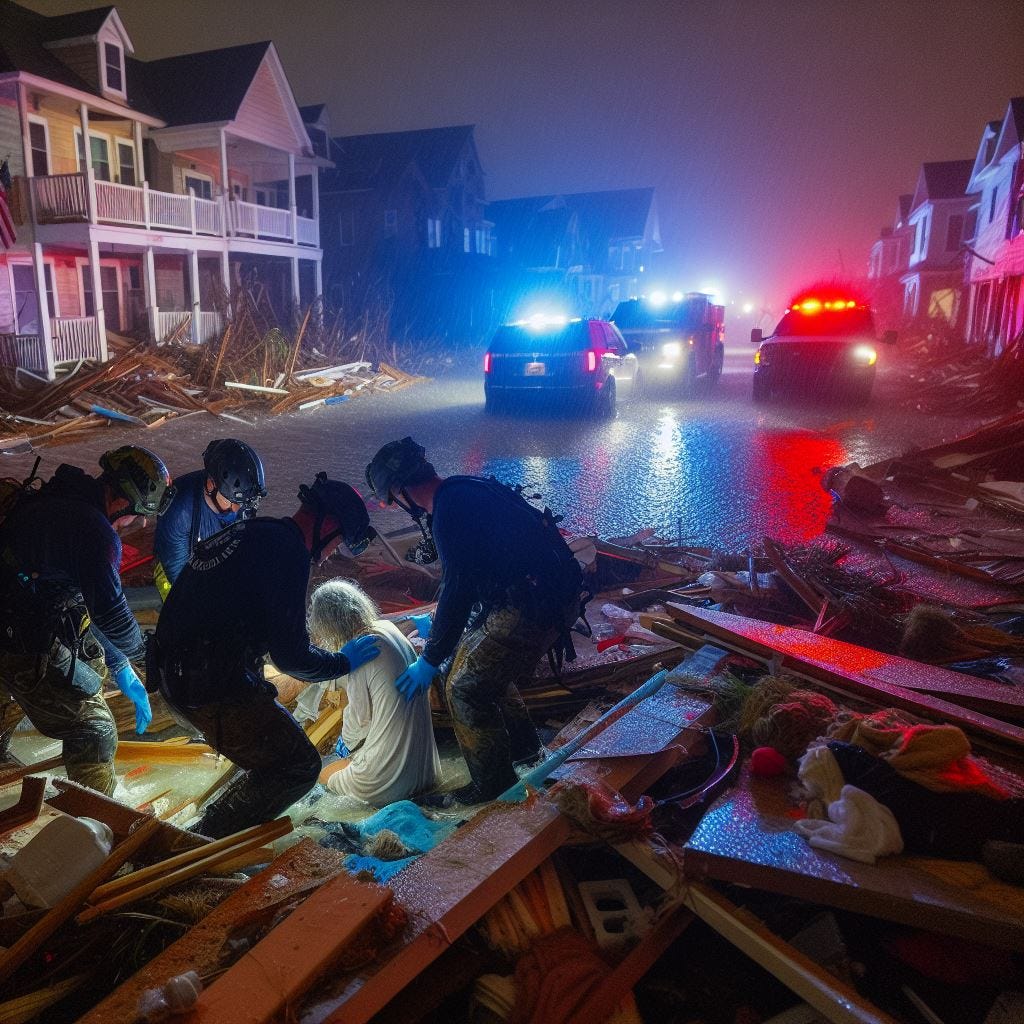
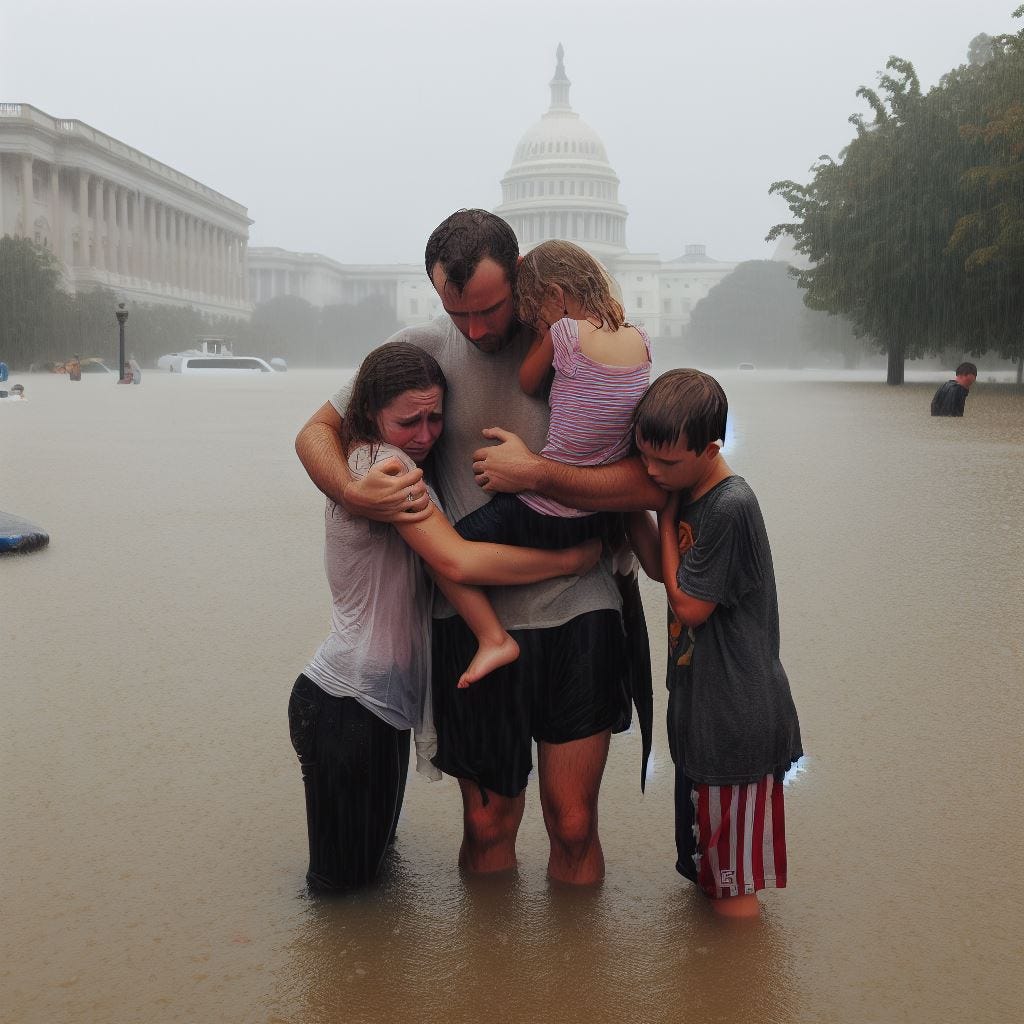
Meanwhile, as Imani drags her feet inland, so do her sprouting thunderstorms. Torrents of rain sit their heavy weight on top of Washington DC and Baltimore, combining with a westward prevailing, 45 mph sustained wind that’s blowing the Chesapeake Bay up the Potomac River. Urban flooding fills the downtown streets, bursting through manhole covers like Yellowstone geysers. Thousands of residential homes face a slow death of ground floor inundation; in contrast with the storm surge down south, here, the water rises slowly, steadily, but is no less unstoppable. Families quail in fear as the water line creeps up their couches, their tables, their chairs and ottomans, their kitchen cabinets and beds. It’s a brown, murky soup, teeming with mysterious debris and flesh-eating bacteria. This begins by the late evening of September 11th, and accelerates during the terrifying, overnight hours. Through the dark of the night, the rain keeps falling—more, and more, and more; an endless supply of unlimited condensed moisture. During every brief lull in the rainfall rate, the city’s residents hold their breath, praying that the watery onslaught from the sky is beginning to taper—but then, the radar speaks the harsh reality. The gaps between the stronger storm cells are filled in as quickly as they appear, by a ceaseless train of swirling rainbands that stubbornly refuses to move. As Washington DC is under continuous torment, the green polygons of Flash Flood Warnings start to be replaced by Flash Flood Emergencies. Urgent evacuations are ordered for the areas nearest to the swelling Potomac River, though in the blackness of the midnight downpour, the process is chaotic, and inefficient.
As a journalist in Hyattsville, Maryland, reported, “By the tick of 6 on the clock that morning [September 12], the sound of raindrops has already pounded my eardrums to tiredness. Overnight, roads have turned in to rivers; and rivers, barreling torrents. Through years of reporting on extreme weather events, never before have I experienced as unremitting a downpour such as this. The residents I have spoken to through the night yearn for one thing, and one thing only: and that is for the rain to stop. They best described the situation as the classic image of a nightmare, in which you are running from a devious creature attempting to kill you, yet your legs feel like they have cinder blocks strapped to them, and the creature keeps gaining ground on you. It is not purely morbid, nor in my interest, to say that many people here may not startle awake from this nightmare.”
With the densest and most copious rainbands shifting heavily to Imani’s northern quadrant, Maryland, Delaware, and Washington DC are already far and away exceeding their predicted rainfall rates for the storm (leading to the overall precipitation forecasts for Richmond, Hampton, Norfolk, and Virginia Beach to decrease, minimizing how severe the freshwater flooding will be in these cities). With surge and violent waves pushing up the Patapsco River, Baltimore becomes a plastic, waterproof pond liner, with every crevice and crease beginning to fill from the insoluble runoff. The industrial docks and shipping channels of Baltimore’s harbors become trashed and clogged with debris from the Chesapeake Bay—this includes pieces of destroyed homes, private boats, and any number of personal belongings.
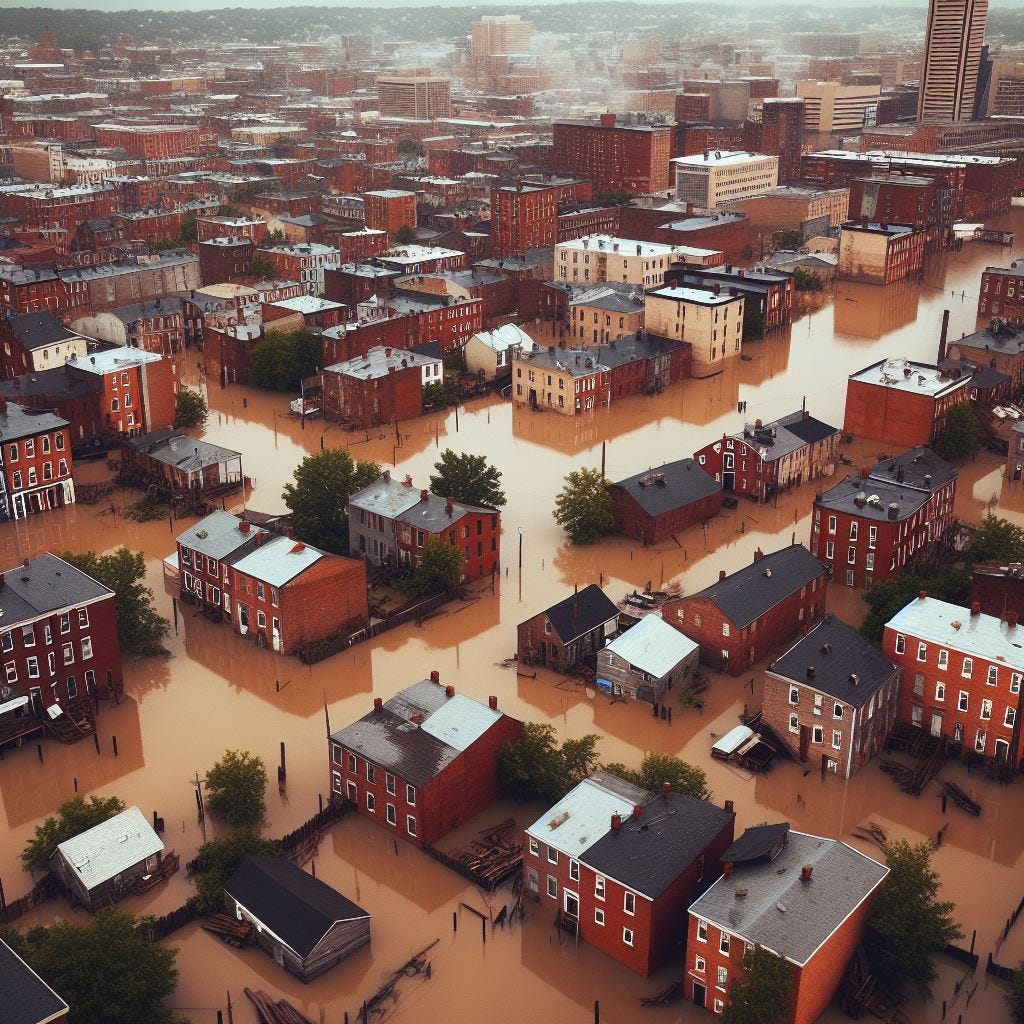
Further to the west, in rural Virginia, Imani’s vast rain shield is leaving a torrid trail of destructive mudslides and flash flooding across the Shenandoah Valley. Orographic lift, instigated by the Blue Ridge and Appalachian mountains, tightly wrings out passing thunderstorms from the tropical storm, accelerating rainfall rates tremendously. The Shenandoah River, having been bitten by this orographic venom, swells outwards, and destroys the tissue of its earthen banks. It is here, where some of the most extreme rainfall accumulations from Imani will be recorded, with totals exceeding 40 inches.
Back in Washington, the catastrophe is reaching a historically unfathomable breadth. Collecting, funneling, and siphoning hundreds of square miles of Imani’s channeling rainfall, the Potomac River is exploding from its shell like the ambitious sprout of a massive tree. Tangled cobwebs of inlets, streams, and small deltas homogenize into a single, ruinous serpent that sweeps through the city, moving behind the weight of countless millions of gallons of water. By the late afternoon of September 12th—with a constant, fresh supply of Atlantic moisture being pulled in to Imani’s circulation to keep the flow of rain replenished—the floods are starting to climax. Scenes reminiscent of Hurricane Harvey’s impact in Houston, 10 years previous, dominate headlines around the world. The crushing jackboot of a historic natural disaster, is stepping on the throat of America’s Capital City.
September 12-13th—Will It Ever End?
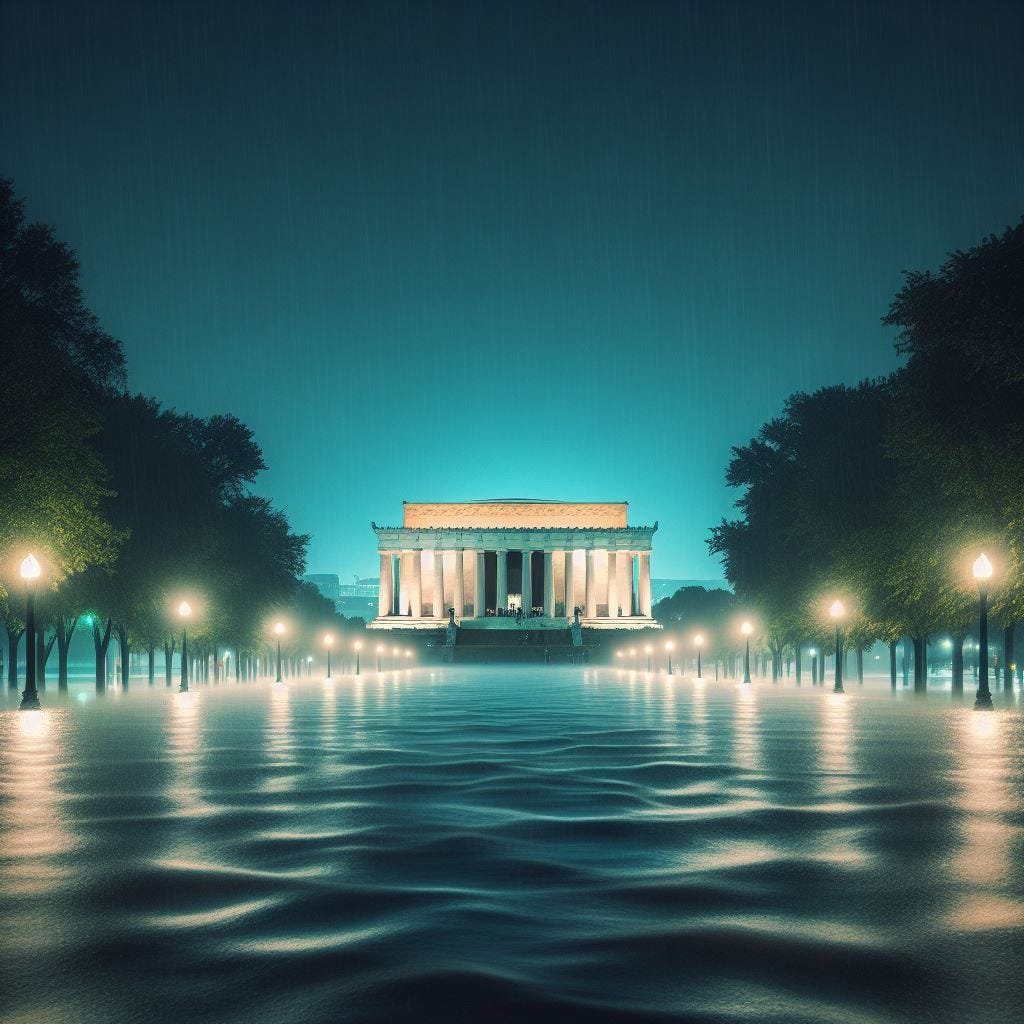
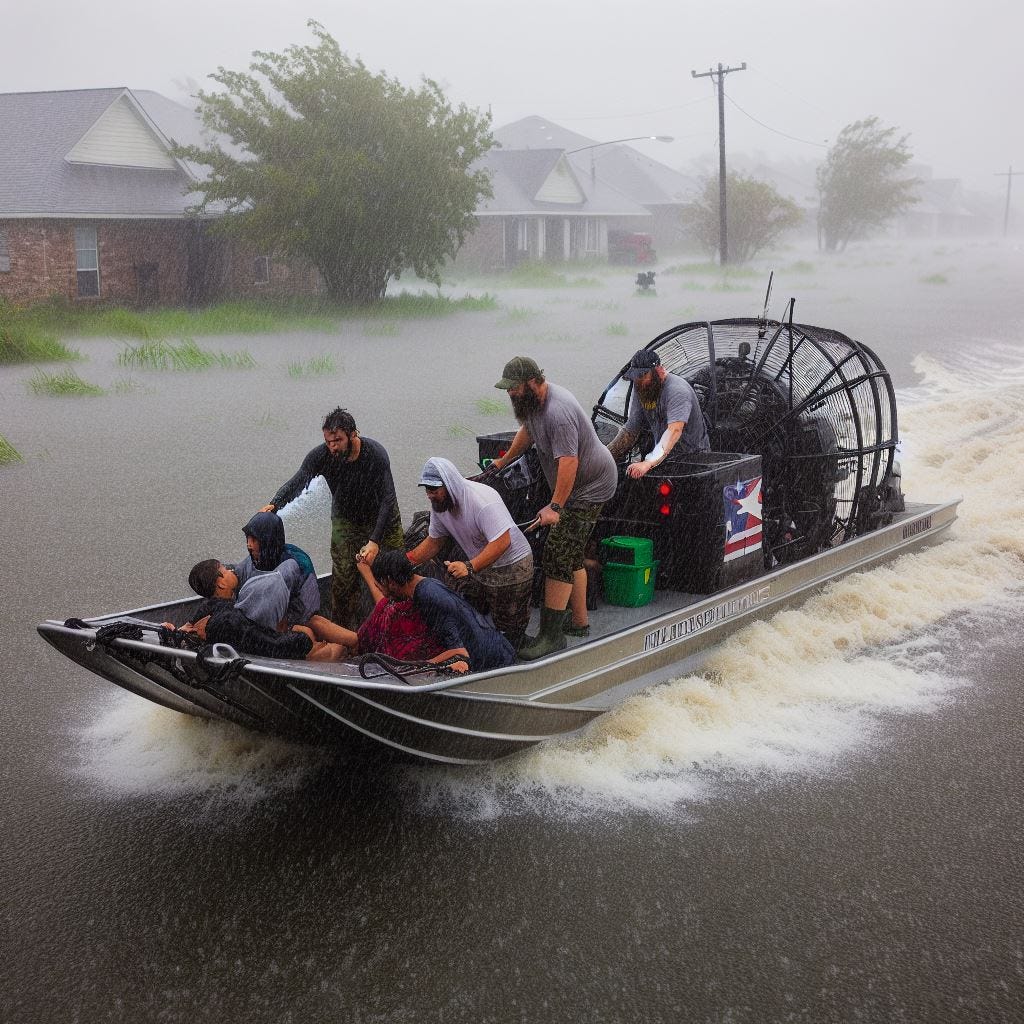
Since their meeting at the Elliott Hotel, Cashman and Akari had been touring Washington DC’s progressively inundated streets. By the overnight hours of the 13th, an opaque gray algae of flooding had pullulated throughout the massive City. Streets and highways had disappeared in hours. Stores and hotel lobbies, besieged and overwhelmed. Vehicles of all shapes and sizes, becoming stranded in the watery antigravity. The Potomac’s efflux of floodwaters was taking an irreversible turn for the absolutely devastating… but now, Cashman had other fears clawing at his conscious.
“17th Street Southwest,” Akari’s voice had rasped over the rabble of the phone line.“38°53’22″N 77°02’57″W. Please hurry, Kirk. I don’t know how much longer we have out here.”
It had been nearly half an hour since that call, and in that time, the phone connections had gone dead. Cashman felt his breathing becoming rushed; he raced to get at least close enough for his handheld transceiver to be in range of Akari’s. He was only a few miles away from her coordinates, but between maneuvering around the flooded roadways, barricades of emergency vehicles, and even the occasional downed tree limb, it’s taken him precious time, and an infuriating train of “make a U-turn” lectures by the GPS, to find a passable route. He lamented splitting up with Akari in the first place, and he chastised himself for letting her convince him into the decision.
“I think we should get closer to the river.”
Cashman had shaken his head. “It’s getting dark, Akari—we’ve seen enough today. With the amount of rain forecast for tonight, I don’t think we’re going to have to get closer to the river to get more footage.”
And Akari’d chewed her lip. “Alright… then I’ll go.”
“What? Didn’t you hear what I just—”
“So? It’s not your decision to make!” she’d snapped. Recomposing herself quickly, and softening her tone, she added: “Look, you know me, Kirk. I’ll be fine. I want to see the worst of this storm, and I’ve already missed Virginia Beach. No, no, this isn’t about your or the team… this is just about me. I’m not missing this.”
“Wait—” he’d opened his mouth to protest, his instincts telling him this was a very bad idea, but Akari was too quick. She waved goodbye and hopped in her car, drove out of the half-flooded parking lot, and away down the road. He watched her leave—the taste of rainwater and burned tire rubber on his tongue—with a growing pit in his stomach…
Now, the lonesomeness of black air and relentless rain, was incredibly eerie, and the pit in Cashman’s abdomen had morphed into a nauseous boulder. As he rounded around the Arlington National Cemetery, his tires began to hiss through water. There were no headlights behind him, and no taillights before him; and he’d seen only a handful of vehicles that weren’t either fire trucks or police cars, in the last twelve hours of driving on what little was left of open road in the city.
The water outside quickly deepened, splashing against the headlights, and creating a strobing effect that mimicked the fluttering of a butterfly’s wings in front of the sun. Then, just as quickly as his car had been enveloped, Cashman’s elevation suddenly increased, and the waters receded as he came up to the Arlington Memorial Bridge. While crossing the bridge’s rain-slicked surface, he saw, in the dappled reflection of the street lamps, the enormously inflated size of the Potomac River, whose rippling currents lapped hungrily at the bridge’s underbelly.
When he came off the bridge, Cashman dove back into the growling shadows of the bursting Potomac; and in the effervescent downpour, he traced the outline of the Lincoln Memorial and Washington Monument, freshly christened islands amongst the endless waves. He tentatively kept his foot on the gas pedal, creating wakes to either side of him. The water was deeper here, and soon, it began sloshing up the hood. It seeped in through the cracks and crevices of the doors; leaking in some places, spraying in in others. Cashman felt the coldness swallow his feet, move up his shins, and then encompass the entirety of the driver’s seat, making him squirm uncomfortably.
He lifted the transceiver to his lips, depressed the button: “Akari? Akari? Do you copy?”
Nothing.
“Is anyone there?” He was just starting to wonder where the hell Akari could possibly be—beginning to feel panic catch like a fishing hook in his throat—when he spotted a single point of light, waving through the branches of the trees surrounding Lincoln’s Doric temple. He immediately recognized the flashing pattern as an SOS signal. The transceiver crackled.
“I… light on the Memorial… caref—Kirk?”
“I’m here!” Cashman patted the car’s dashboard in apprehensive relief. “Akari, is that you? I’m on Independence Avenue.”
“I see—r headlights!” came Akari’s heavily muffled response. He realized that it was not actual radio interference, but the pounding of the rain on the other side, that was making it so difficult for him to decipher her words.
Feeling pressed for time, Cashman pumped the brakes slowly, stopping short of the line of bollards separating the road from the visitors walk, but curling his tires to swivel his headlights onto the steps of the Lincoln Memorial. He estimated that he was just over a football field’s length away from what he dearly hoped was Akari. Out the window, the floodwaters rippled and undulated; he swore he saw them getting higher right before his eyes. He braced himself against the door, forced it open against the water’s inertia, creating dark, swirling eddies and powerful splashes as he did. The rain cascaded in viciously. He stepped onto the unseen pavement, catching his breath as the water rose to just below his sternum. Squinting, he was now able to make out Akari’s opaline hair glowing in the glare of his headlights. She was, indeed, standing at the top of the Memorial’s grandiose granite steps, surrounded by what looked to be two hunched over figures. “Akari?” he spoke into the radio.
“Kirk, are you there?” Her voice was still muzzled, but was coming in clearer than before. Her tone was unsteady, even desperate.
“I’m here.”
There was a hesitation on the other end, followed by an imperceptible mumbling. “The river literally came up in seconds, so we had to hunker up here,” said Akari quickly. “I’m here with a couple and their grandson. They’re too old to swim, and their kid doesn’t know how. I parked the car further down Independence Avenue, but I couldn’t get back to it before the water got over our knees. You’ve got to come get us.”
Cashman muttered something obscene under his breath. “Who are these people and why are they out here? And how did you get yourself into this?”
“…I’m prone to making substantial errors in judgement.”
“Since when?”
“Since I agreed to chase Hurricanes with you.”
Cashman shook his head. “I’m coming to get you,” were his final words over the radio. He trudged back a few steps to the car, plunged his hand down and pulled out the two life jackets stashed beneath the driver seat. He backed out of the cab and forced the door closed. He knocked on the glass and added: “Don’t go anywhere, Newt.”
This was not the first time Cashman had trekked through chest-deep floodwaters; but the darkness of the Mid-Atlantic night evoked a primordial fear within his being. He took a deep breath, trying not to falter in the urgency of his steps. The currents below the surface swirled in unison, in a single, overpowering direction; and the coldness seeped into every last fiber of his clothing. His blood curdled as objects of strange shapes and textures brushed against his legs. Finally, he reached the steps of the white marble mansion, and an enormous tension was lifted off his shoulders. Akari was quickly at his side, giving him a hand as he emerged from the black liquid.
“Took you long enough,” Akari grunted as she pulled him up, briefly embracing him in a tight hug that Cashman hadn’t felt in years. She released her grip as quickly as she’d initiated it, backing off self-consciously with a brush of the soaked strands of hair that were sticking to her face. She gestured to the hunched-over man and woman, whom were leaning against each other, along with the child that clung to their legs. “This is Ed, Sherry, and Michael,” Akari explained rapidly. “We need to help them and get them to Newt, before the river rises any higher.” She dared a look down at the water’s surface, trepidatiously.
Cashman’s eyes flashed over the shivering trio sonically, noting Ed’s heavy-set physique, Sherry’s frail figure, and Michael’s tiny limbs. “I don’t know… maybe we should wait it out,” he offered, blinking away the torrents pouring over his face while he deliberated. “I don’t think the river’ll get up this high.”
Akari shook her head furiously. “We can’t do that, Kirk! If we’re wrong, we’re—” and the word ‘Dead!’ was never spoken, by the glance of the wide eyed boy, Michael, clutching at his grandparents grasp in unmitigated fear. She looked at Cashman seriously.
Cashman still didn’t like this situation. Looking out over where the memorial’s Reflecting Pool had homogenized itself with the rest of the landscape, at the tops of the trees sticking out, and the Washington Monument towering out beyond that, he said: “We could wait and see if the rate slows do—”
“We don’t have that kind of time!” said Akari adamantly.
Cashman gnashed his teeth. “Fine,” he said reluctantly, “but in that case we can’t afford to wait another second.” He approached Ed first, but the old man didn’t hesitate to push him away, insisting vehemently that Cashman take his wife, Sherry, first. Cashman obliged, and took the woman’s feeble arms around his neck, and slipped one of the life vests over her head. He handed the other vest to Akari, whom had already hoisted Michael over her chest and shoulder.
Step-by-granite-step, Cashman lowered himself back into the lurking floodwaters, with Akari following closely by. He heard her trying to comfort Michael’s childish whimpers, which turned into yelps of fright when the water touched his feet.
“You’re going to be okay, Michael,” Akari reassured, straining to squeeze the waver from her voice, and maintain her confidence. “I’ve got you… don’t be scared, okay?”
Michael nodded uneasily, terror written over his youthful expression.
They trudged forward stiffly, weighed down by the heaviness of their clothes, in the direction of Newt’s headlights. Cashman scanned the water’s surface tensely, trying to make out shapes in the disorienting ripples surrounding his vision. He instructed Akari to follow right behind him as he spotted the silhouette of a large tree branch moving with the flow of the floods. A bolt of thunder that had no flash of lightning jolted his muscles. Sherry jumped so violently from the crackle, she nearly banged her forehead against his chin.
“We’re alright!” Cashman yelled, putting his arm around Sherry strongly. “We’re almost there—you’ve got this!” He worried if the aged woman could actually hear his words over the roar of the rain’s pattering on the surface of the water, but to his relief, she nodded her head in acknowledgement.
They made it to the car in five minutes, and Cashman opened the rear doors; hoisted Sherry inside. Akari took Michael off of herself, and Cashman lifted the terrified child by his armpits, and placed him beside his grandmother. Sherry looked around wildly and wailed, “Your car is flooded!”
“It’s an amphibious car,” Cashman stuck his face in the narrow opening of the door as he pushed it closed. “You’ll be safe here—we’ll be right back.”
Akari and Cashman held hands on the way back to the Lincoln Memorial, feeling the currents now pulling stronger than before, but having no complications on their return. They took a hold of Ed from either side, and tediously, guided him into the water. The old man gasped and spluttered, his feet sliding on the slippery concrete concealed underwater. Cashman felt the muscles in his lower back suddenly strain in keeping Ed upright; Akari grunted as well, her knees shaking. Once they steadied Ed, they began the treacherous wade back to the car.
They were less than halfway across the one-hundred yard distance, when a surge hit Cashman from the side. Suddenly, he was submerged, his feet slipping out from under him, his face eyes blind. Ed’s weight disappeared in a flash. Akari was nowhere to be seen. Cashman flailed frantically, searching for the pavement as he felt his body separate from the Earth’s surface. Somehow, he managed to regain traction; when he straightened his back, his face re-emerged into the air. The water was now up to his collarbone, and threatened to sweep him into an unknown oblivion at any whim. His head whipped around desperately; he’d floated a few yards outside of the illuminating beams of Newt’s headlights, and was now enveloped in the wildering darkness.
“Akari?” he screamed. “Ed? Akari! Where are you!”
“Kirk—”
Cashman snapped at the direction of Akari’s brief cry behind him. He saw nothing for a terrifying second; then, her white head popped up from the surface. He launched himself towards her, sweeping his arms in long strokes. He realized quickly, however, that he was swimming against the Potomac’s current; and he could feel the horrifying fruitlessness of his efforts. He swam harder, and the river seemed to flow faster in response. Then, out of nowhere, a baseball bat slammed straight into his back. He inhaled and choked on a mouthful of the grimy water, retching for air.
Regaining his bearings, Cashman surface, realizing he was now pinned against a tree. He grabbed a hold of the coarse bark, seeing that he’d been knocked into the small patch of forest surrounding the Korean War Memorial. Glancing over his shoulder, he once again spotted Akari’s head—and this time, Ed’s as well—jouncing up and under the surface like fishing bobbers. They were just seconds away from careening into the tree patch as well.
“Grab hold! Grab hold of the trees!” Cashman screamed. He watched helplessly as Ed disappeared into the forested labyrinth to his right; thereupon, he turned to see Akari barreling straight in his direction. Wrapping one arm on a low branch, he outstretched his other one, extending until his bicep tendons shrieked.
Between gasps for breath, Akari’s eyes lit up when she saw Cashman hanging from the tree trunk. “Kirk!”
“Take my hand!”
Akari reached out. Cashman caught her ghostly, glistening wrist in his grip, and squeezed hard, confident he could hoist her against this current.
“Hold on!” I’ve got you—” and just as soon as he said it, she was gone, her hand ripped violently from his grasp, like a slippery fish back into the water. A horrid, gnarly branch of black points and gleaming devilry had rolled over where Akari had been just seconds previous, churning in the water like an alligator lurching over its prey.
Without hesitation, but stiffly trembling in terror, Cashman plunged urgently in the direction of the branch and Akari. Blinded by water once again, he kicked and scrambled, hoping to feel something underneath the abysmal veil—and was painfully rewarded as his thrashing limbs came down on the sharp spokes of the branch. He felt his skin slice open from the thick muscle of his right forearm, to the bony bulge of his wrist; but he managed to grab hold of the log anyway, and pull his body closer to it. Immediately, he felt soft flesh and a rubbery rain jacket tangled in the branch’s offshoots. Akari was trapped beneath the surface, her coat mangled in the branch. Cashman felt her writhing frantically, and a blinding ache hit his cheekbone as her elbow flew into it. Cashman swam forward still, his muscles burning, trying to corral her panicked frenzy. His lungs wanted to explode. His heart pounded in his ears; and he begged, silently, for Akari to stop her struggle.
At Cashman’s first touch, Akari wriggled harder, stronger, like he was a shark that had sunk his teeth into her flesh… but then, as his hands grabbed control of her arms, firmly but gently pulling them into a calmer state, Akari’s muscles suddenly relaxed, melding into Cashman’s control. Fighting the incredible desire for air, Cashman methodically threaded Akari’s arms out from the rain jacket—which had been pierced and snagged by several of the branch’s hook-like arms. Then, she was free, her body sliding smoothly into his embrace. Together, they swam out from under the log, and broke the surface, gasping vehemently for air. They lightly found their footing and treaded water for a few more feet, before they stumbled on the underwater posts outlining the walking paths throughout the Korean War Memorial. They anchored themselves here, taking a moment to catch their desperate breaths in each other’s arms.
Cashman’s lips felt numb from holding closed for so long; and his skin stung where it had been cut. After several gasps, he touched her cheek, said: “Are you okay—”
Akari buried her head in his shoulder; weak, and shuddering. Cashman said nothing more—for nothing else needed to be said.
The blinding glare of headlights flashed between the trees. A few minutes later, Cashman and Akari were rocked by a rolling swell; and then, there was Newt, sitting on Independence Avenue, the cab light on, and rear door open, only a few yards away. Warily, Akari and Cashman followed the guard rail posts down the concrete path leading to the street, craning their necks to stay above the water, and bracing for an underwater impact. None came, and they made it to the car; Ed was there in the backseat, and he pulled them in. Sherry was behind the wheel; and suddenly, Cashman felt bad for having underestimated this pale, venerable woman.
Cashman was bleeding mildly from his arm… the dark shape of the crooked branch was still engrained in his vision; the feeling of the vacuum that had ripped at his lungs, still fresh; and the shaking of his muscles, still visible.
Bloody blotches stained Akari’s shirt where her back and shoulder blades had been gashed; she was likewise trembling heavily, clasping her hands together to stop their shaking. Michael, the young boy, scooted over from where he sat in the far right of the back seat. He hugged Akari, just barely able to wrap his arms around her abdomen.
“Don’t be scared,” said Michael in his high-pitched, immature voice. “…remember?”
Akari, surprised for a moment, stared down at the child’s wide eyes. Then, she laughed—small, slight, melodious—and a tear fell down her cheek. Her trembling dissolved, and she brushed Michael’s soaked hair from his brow and forehead.
Sherry looked back around the headrest. “Are you kids okay?” her face was both contorted by concern and softened by kindness.
“We’re fine, Sherry, just a few scratches,” Cashman breathed gratefully. He patted a hand on the elderly woman—who was but half an hour ago, a complete stranger to him—and smiled. “Thank you—thank you for saving us,” his words were simple, but they brimmed with an indebted gratitude that could not be communicated vocally. He saw in the wise light of Sherry’s eyes, that she understood.
“Can we get the hell out of here?” Ed broke in abruptly. He shifted in his seat, grimacing at the waters that still lapped over his legs. “Before this damn river carries us to the front door of the White House?”
“Right.” Cashman guided Sherry into the passenger seat, and he crawled into the driver’s side. They drove towards downtown, and soon, the water level lowered, allowing Newt’s cab to drain back out (though they never became fully clear of the Potomac’s floodwaters, as every street seemed to have at least six inches of inundation over them). The air inside the car was wet, relieved, and humbled; a bittersweet aroma of consolation that they had made it out alive… and sorrowful disquietness of the countless flooded buildings—federal, public, and private—that they were passing. The flashing of red, orange, and blue, reflected along the city streets, told of the extent of the horror in the city. It was a surreal sort of dread… but they had survived. And they knew without knowing, that so many others were not—and would not—be so lucky, by the tempest’s end. They focused on getting to the warm dryness of the Elliott Hotel the rest of the drive.
At one point, Cashman glanced over his shoulder—only once, but a meaningful once, because he locked eyes with Akari in that moment. She had taken Michael in her arms, and was comforting the child affectionately. There was just the smallest of smiles on her face—it was a face that was covered in grime and miscellaneous grub… but none of that mattered to Cashman, because she was smiling. He forgot—as did she—the rift that had grown between them. What they saw in each other’s eyes was something that only they themselves, could ever understand. “Just like the good ol’ days…”
And outside, Imani cried—for the prey she had beckoned had slipped right through her grasp.
September 14th—”All Quiet Along the Potomac”.
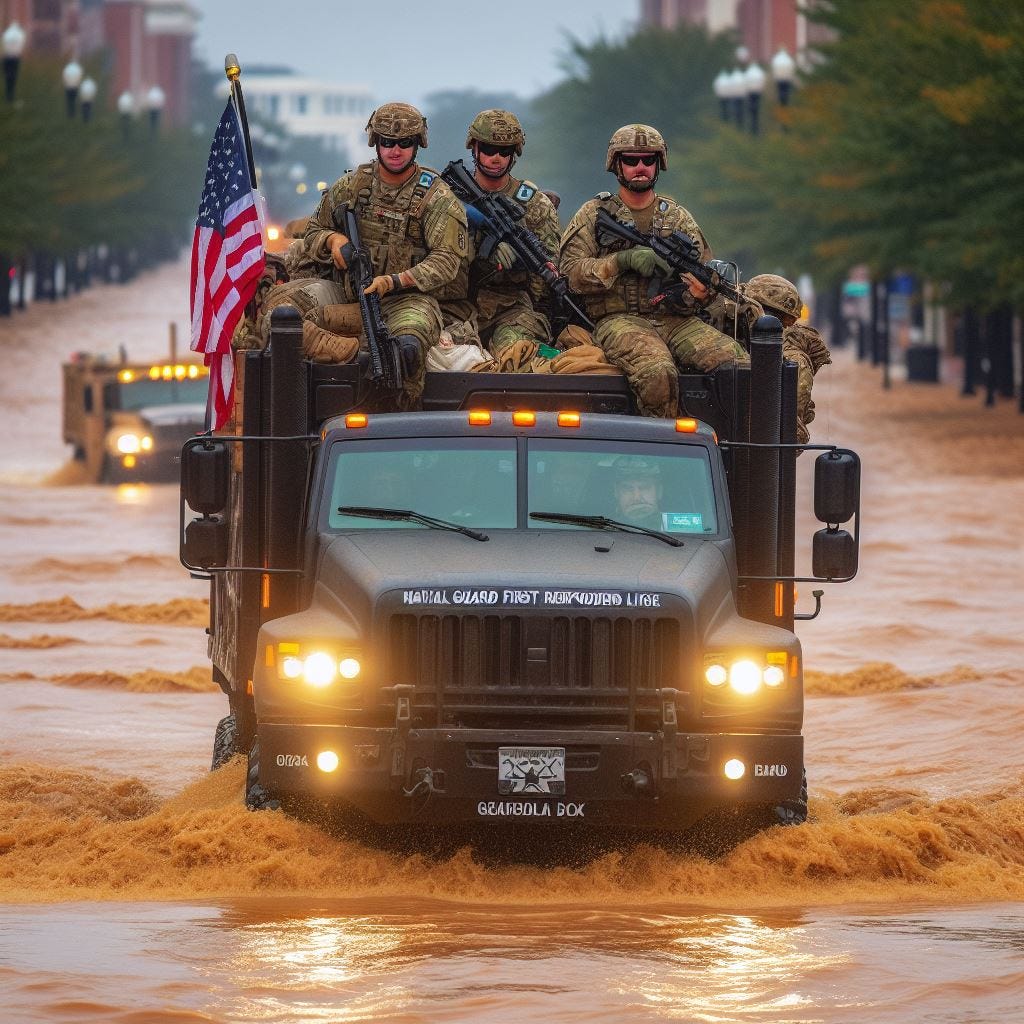
Overnight, on September 14th, 2027, the impossible glimmer of hope starts to shine just a little bit brighter for the residents of the DC-Baltimore metro complex. The rain… is weakening; and Imani, after more than 3 days of plaguing the Mid-Atlantic states with the diseasing side effect of a rainy overdose, is starting to lose her luster. It has taken days, but the storm’s slow crawl has finally brought her far enough away from the Atlantic Ocean to cut off her supply of oceanic moisture. Her rainbands diminish, spiraling into evaporation. She transitions to a Tropical Depression, and promptly thereafter dissipates as an extratropical system over central Pennsylvania. Her remnants will eventually curve out back over the Atlantic, after crossing Nova Scotia, to ultimately have her enormous circulation absorbed into the Arctic’s frigid void.
In the catastrophic wake of Imani’s aftermath, virtually half of Virginia’s geographical area has experienced flooding of some shape, form, or magnitude. With 6 different major U.S. cities having been on the receiving end of devastating floodwaters, Imani’s damage estimates punch through the historical ceiling. The price tag rockets to at least $250 billion in damages, easily leapfrogging over the previous record holders of Hurricanes Katrina (2005) and Harvey (2017). This also makes Imani the costliest Hurricane in US history when adjusted for inflation, a record previously held by the Great Miami Hurricane of 1926.
As the bodies are counted in the weeks following the storm’s devastating landfall, the original estimate of 10,000 missing people is, indeed, a steep exaggeration; but nevertheless, the ultimate toll is no less heartbreaking. From rip current deaths in Palm Beach, Florida, to the violent drownings as far north as Chincoteague, Virginia, Imani is delineated responsible for 256 direct fatalities along the Eastern Seaboard’s beaches. An additional 77 drownings come as a result of the flash flooding in Washington, Baltimore, Wilmington, and Philadelphia; as well as more rural towns in Virginia, West Virginia, and Pennsylvania. When culminated with indirect casualties in the aftermath of the storm, from factors such as carbon monoxide poisoning, electrocution, heart attacks, lack of an adequate supply of medications, clean-up accidents (chainsaws, ladders, etc.), and homicides related to looting, Hurricane Imani’s total enumeration exceeds 400 individuals.
5,000 National Guard troops are deployed to Maryland, Virginia, and North Carolina on September 14th. As the water recedes in the following week after landfall, looting germinates throughout evacuated areas of the major cities impacted, prompting the Guard’s presence to eventually be extended. The coast guard is also called in, and they perform over a thousand air rescues of people stuck on their roofs and second floors.
Overwhelmed shelters become densely packed with those who have lost their homes. And while no significant structures in DC or Baltimore have been pulverized or flattened, as was the case on the Chesapeake coast, the ground floor water damage for hundreds of thousands of properties will necessitate extensive and costly reconstructive repair. 109 counties across the Mid-Atlantic are declared disaster zones, becoming eligible for government aid. At the height of the storm, nearly 8 million customers on the East Coast are without power. Overall, Hurricane Imani becomes recognized as being among the worst storms of all time to affect the United States of America.
“Hurricane Imani” has not happened—she is a figment of the imagination, a product of possibility, and a construct, of the theoretical. Could a Major Hurricane make it that far north? Could a tropical cyclone push a >15 foot storm surge up the Chesapeake Bay? Could a degrading tropical system stall over Virginia, and explode the Potomac River into a massive, barraging swamp? The answers to these questions are all an unequivocal yes—and this is supported by numerous, historical analogs, examples, and data. As examples: the 1938 New England Hurricane maintained Cat 3 winds as far north as Long Island, New York; Hurricane Hugo’s enormous size shoveled a 20+ foot storm surge into South Carolina’s similarly surge-vulnerable coastline; and 2018’s Hurricane Florence, post-landfall, stalled out for days over the Carolinas, dumping over 30 inches of rainfall in some locations, leading to catastrophic inland flooding. All it would take is for these factors to come together in the right place, at the right time, to create the true, Hurricane Imani.
Could this scenario happen in 7 months? In 3 years? In 30? There is no way to know—but something that is of no dispute, is that the “River of Swans” is a duckling sitting in the Lion’s Den. Virginia’s coast—and the dense, urban centers of America’s most critical Eastern Seaboard infrastructure that populate its length—is just waiting to be caught in the vicious jaws of a Major Atlantic Hurricane.
It’s just a matter of time.
 BACKPIRCH WEATHER